The song 'Nina' by Ed Sheeran is about an artist who had to choose between his girlfriend or his career, and he chose to try and pursue his career in the music industry.
For the camera work, we would begin shooting the artist going on stage and touring on his own, but we would be able to see (as an audience) that he is uncomfortable and is missing his girlfriend. There would then be a parallel cut to the girlfriend, Nina, who wants to be with his Boyfriend however he can only have one choice. However the artist is adamant that he cant be with her any more because he now 'lives on the road'. We can then see his career develop and for it to go wrong as he starts to take drugs and has been synthesised by his record label.
Friday, 12 September 2014

Thursday, 11 September 2014
My Second Idea
My second idea:
The song Travelling Alone by Passenger is about two stories. the first part of the song is about an older couple who both decided once they have saved enough money up and once they have retired, they would travel the world together. This is because neither of them went travelling before and they needed to stay in work until they saved the money. However, sadly, a week or so before they were going to go travelling together, the wife suddenly and sadly passed away. Despite this, the husband still had the bravery to travel around the world on his own. The second part of the story is about a couple who were in a relationship for over 10 years had broken up after the soon to be husband cheated on his girlfriend. The lyrics both mirror each others stories as to how difficult life is and how they have to cope with their individual circumstances.
We would start by shooting the man sitting on his own, with people walking past him and him feeling sorry for himself. He would then stare at a picture of him and his wife. We would then track him and emphasise situations, such as dining for two, where he can only dine for one. This would then create an emotional bond with the audience as we don't want him to feel lonely.
The second part of the song would then start and we would see her burst into tears and talk about his ex boyfriend, we would cross cut to the boyfriend find a new girlfriend and cut back to see how she suffers. We can see a shadow of the couple holding hands. the video would end of the old man from the first part of the video, meeting the woman from the second part of the video. This would come together as continuity editing.
The song Travelling Alone by Passenger is about two stories. the first part of the song is about an older couple who both decided once they have saved enough money up and once they have retired, they would travel the world together. This is because neither of them went travelling before and they needed to stay in work until they saved the money. However, sadly, a week or so before they were going to go travelling together, the wife suddenly and sadly passed away. Despite this, the husband still had the bravery to travel around the world on his own. The second part of the story is about a couple who were in a relationship for over 10 years had broken up after the soon to be husband cheated on his girlfriend. The lyrics both mirror each others stories as to how difficult life is and how they have to cope with their individual circumstances.
We would start by shooting the man sitting on his own, with people walking past him and him feeling sorry for himself. He would then stare at a picture of him and his wife. We would then track him and emphasise situations, such as dining for two, where he can only dine for one. This would then create an emotional bond with the audience as we don't want him to feel lonely.
The second part of the song would then start and we would see her burst into tears and talk about his ex boyfriend, we would cross cut to the boyfriend find a new girlfriend and cut back to see how she suffers. We can see a shadow of the couple holding hands. the video would end of the old man from the first part of the video, meeting the woman from the second part of the video. This would come together as continuity editing.
3 ideas for the music video- My 1st idea
I will be in a group with Ethan Wall this year for the media project. We have each come up with 3 ideas, so we can then compare our ideas, pitch it to the class, and gain feedback and agree to what idea we will choose.
My first idea:
The first idea I had in mind was using the song 'Dance With My Father' by Luther Vandross. This is narrative based lyrics which is about a young boy growing up who has lost his father, which had happen to the songwriters, Luther Vandross and Richard Marx. This song can relate to many people, and so with the correct visuals, it would express and emphasise the emotions.
The main visuals would start as a baby/little boy and see him grow up with his dad and so the audience can see that the two characters have a strong bond between each other. We would then cut to the iconic shot from the Pursuit Of Happiness and then fade the father out of the shot which just leaves the boy on his own. From listening to the lyrics and seeing these visuals we can see he has died. We would then cut to the family's reactions and cross cut to the boy (who would now be grow up through a time ellipses, to be lip singing the words. Another parallel edit would be made of the father and son dancing with each other in a ballroom that is empty. This is an intertexual moment from Corrination Street, where Roy and Hayley share their last dance together in a wonderful ballroom in Blackpool. Although their situation was a marriage, and dance with my father is a father and son, it will still be just as emotional as there is a death involved and it is their last dance together.


My first idea:
The first idea I had in mind was using the song 'Dance With My Father' by Luther Vandross. This is narrative based lyrics which is about a young boy growing up who has lost his father, which had happen to the songwriters, Luther Vandross and Richard Marx. This song can relate to many people, and so with the correct visuals, it would express and emphasise the emotions.
The main visuals would start as a baby/little boy and see him grow up with his dad and so the audience can see that the two characters have a strong bond between each other. We would then cut to the iconic shot from the Pursuit Of Happiness and then fade the father out of the shot which just leaves the boy on his own. From listening to the lyrics and seeing these visuals we can see he has died. We would then cut to the family's reactions and cross cut to the boy (who would now be grow up through a time ellipses, to be lip singing the words. Another parallel edit would be made of the father and son dancing with each other in a ballroom that is empty. This is an intertexual moment from Corrination Street, where Roy and Hayley share their last dance together in a wonderful ballroom in Blackpool. Although their situation was a marriage, and dance with my father is a father and son, it will still be just as emotional as there is a death involved and it is their last dance together.
Digipack Practice- Kula Shaker
This year we have to create a digipack, however we knew that we need some practice before hand in order to experiment with the editing software. The activity was to find individual images and edit them together using a number of tools in order to create the Kula Shaker album cover.
First we had to crop the images down in order to make it the correct size and shape. The original background trees were bright green, so in order to make them more like the original, we had to invert the colour. Next, we had to colour balance the trees, we did this by adding more cyan and less green to the picture. We had to drag the other two images, and on both occasions we had to remove their backgrounds of those separate images. We did this by using the eraser tool and the magic wand mask tool.
 |
| My re-creation |
 |
| Original |
Saturday, 6 September 2014
Lip syncing task
The following clip is our lip syncing task, where my group and I filmed and edited a clip in order to understand the importance of getting the lip sync correct and in time to the music, while also adding a number of new editing techniques.
For our lip syncing task, we chose the song 'Too Close' by Alex Clare. By filming and editing the music video, we were able to gain valuable skills in order to develop our editing skills, and learn the new tools as the editing system has been updated. During the filming, we had the music playing in the background so we could make sure the lip singing was kept in time, so when we added it to the editing software, the timing was good. We could then cancel the sound of the background music in the editing room and then added the official audio clip to it. We added a title at the beginning as we forgot to film something before the singing so it was added as an introduction. This is a mistake we can learn from before we film the real task. We also added a number of different transitions to make the flow of the video better and try and use and discover as many techniques as possible. The first video edit we made was to duplicate the same clip 4 times and put it in each corner of the screen. We then zoomed in, using Adobe Premiere Pro to the mouth, which acted as an extreme close up. During the next instrumental, we had to film more footage, doing something a bit different, so we had to re-film after editing the majority of the footage. Therefore we can learn by this through taking our time when we film the real music video and film each shot a number of times so we have a wider variety to choose from. Soon after, another transition was made, and we filmed Daniel Aboudy and edited it in black and white. The next clip we added a trio of colours to, which made it look more modern and funky. The video ended with a two shot of Daniel and myself lip singing to the video. The task overall helped us to get used to the new software, to develop our video edits, as well as getting to know a larger variety of different transitions.
For our lip syncing task, we chose the song 'Too Close' by Alex Clare. By filming and editing the music video, we were able to gain valuable skills in order to develop our editing skills, and learn the new tools as the editing system has been updated. During the filming, we had the music playing in the background so we could make sure the lip singing was kept in time, so when we added it to the editing software, the timing was good. We could then cancel the sound of the background music in the editing room and then added the official audio clip to it. We added a title at the beginning as we forgot to film something before the singing so it was added as an introduction. This is a mistake we can learn from before we film the real task. We also added a number of different transitions to make the flow of the video better and try and use and discover as many techniques as possible. The first video edit we made was to duplicate the same clip 4 times and put it in each corner of the screen. We then zoomed in, using Adobe Premiere Pro to the mouth, which acted as an extreme close up. During the next instrumental, we had to film more footage, doing something a bit different, so we had to re-film after editing the majority of the footage. Therefore we can learn by this through taking our time when we film the real music video and film each shot a number of times so we have a wider variety to choose from. Soon after, another transition was made, and we filmed Daniel Aboudy and edited it in black and white. The next clip we added a trio of colours to, which made it look more modern and funky. The video ended with a two shot of Daniel and myself lip singing to the video. The task overall helped us to get used to the new software, to develop our video edits, as well as getting to know a larger variety of different transitions.
Monday, 1 September 2014
Phillip Phillips- Raging Fire
Raging Fire is sung by Phillip Phillips, who won American Idol in 2012. This music video analysis will focus on the editing and visuals of the video, which are extremely unique.
As the music starts, there are a number of quick cuts in time to the beat of the music, filming the artist, Phillip Phillips, who is stood in the same position however, in a number of different locations. This gives the music video an instant eye catching and unique feel to it.
As the music starts, there are a number of quick cuts in time to the beat of the music, filming the artist, Phillip Phillips, who is stood in the same position however, in a number of different locations. This gives the music video an instant eye catching and unique feel to it.

In the locations filmed,
there are different settings; consisting of different buildings, street
graffiti, and even being filmed on the train. This gives the music video a modern feel to
it. The camera work shows a number of different shots, from close ups, medium
shots, and extreme long shots, which becomes a repetitive pattern. The quick change of shot types, and the quick
rhythm of the song, helps the editor to make a variety of montages in the
video. Both urban and rural areas were
chosen as locations which also helped the contrast and the flow of the shot
types.

There is a parallel edit to Phillips laying on white paper and other
people are painting a fire around him, which reflects the name of the song.

A parallel
cut is made back to Phillip Phillips in the city location playing his guitar and
singing raging fire. Close ups are made on both the instrument and the mouth. This shows he is an organic artist, as the director is not selling his looks, he is selling his voice and ability to play guitar.

As the chorus begins, the cuts are quicker and the tempo is raised. Quick whip
zooms are made of the locations as the next chorus kicks in.

Another parallel
cut is made back to the painting scene, and ellipses is used as an editing
technique, as the painting quickly evolves, in fast motion. This is a clever
way of breaking up the video and changing scenery. This keeps the audience’s
attention and prevents them from boredom from the repetitiveness of the
footage.
There is a cut to a close up of Phillips hand being painted in red,
after the rest of his body is also painted, the whole fire comes together; which helps the continuity of the video.

At the end of the video, the artist gets up
and it leaves a great look to the painting.
From this music video I can learn to cross cut in the music video to create two stories or to keep the audience engaged with the video. From this video I can also learn the effectiveness and importance of cutting in time to the beat.
From this music video I can learn to cross cut in the music video to create two stories or to keep the audience engaged with the video. From this video I can also learn the effectiveness and importance of cutting in time to the beat.


Thursday, 17 July 2014
Macklemore and Ryan Lewis- Same Love
In order to be prepared by the time we create our music video, it is important to research a variety of different music videos and see how the visuals relate to the lyrics.
The first music video I will analyse is 'Same Love' by Macklemore and Ryan Lewis, which fill focus on the combination of lyrics and footage coming together. This is a narrative based music video which amplifies the lyrics:
The music video begins in the setting of a hospital, where there are close ups on the equipment being used such as putting on gloves and using a blood pressure monitor. Throughout the entire video there is no non-diegetic music, therefore we cannot hear the ambient sounds of the monitors and the characters talking. The pan shot of the hospital bed with a pregnant women lying down on it is significant as we see the beginning of a baby's life. After the baby is born and we see a close up of the mother holding on to him and kissing his hand.

A cross cut is made to the next scene, where there is a time ellipses to primary school different sex children playing outdoors together, showing that he mixed with both genders growing up. Next, there is a parallel cut to a playback of a video when the boy was younger and kissing another girl which is the way he felt being brought up was the 'norm'. However the lyrics explain how he was gay since the "3rd grade" which made him feel uncomfortable, differing from everyone else.

Another time ellipses has taken place in the editing when we see him as a teenager, playing spin the bottle with his friends. however we could tell from the visuals that he did not feel comfortable and he hide his feelings to himself in his room, crying. The lyrics mirror the visuals as he "cant change even if he tried" as his feelings are fixed. The party he attended after this, his was isolated as there were heterosexual couples together around him.

These 3 lines show how loosely the term ‘gay’ is being used and the way people use it. People use it in a derogatory term, which is not fundamentally correct however the song explains how not enough people are standing up for them:
The lyrics emphasise how hard it is for some gay couples to ‘come out’: “Bunch of stereotypes all in my head, a preconceived idea of what it all meant”. Furthermore, many homosexuals are fearful of people treating them differently just because they like the same sex.


After a straight cut, we see a marriage proposal from a low angle in a high key lighting setting of the sun shining down on them. This emphasises the natural act that is taking place is a natural environment. The lyrics show that peoples attitudes are more significant than the law "no laws are going to change us, we have to change us".

The final scene is in the hospital, which is the same setting as the opening scene. The time ellipses is emphasised due to the change in looks over the couple; as they are both elderly where one is not healthy. A flashback is made to the mother holding hands with the baby from the opening scene which illustrates the life cycle. The change in look over time using time ellipses is something I would like to mirror in the music video our group will create.


The music video as a whole illustrates how attitudes towards gay couples, in a post-modern society, are negative and how it has to change and become more acceptance as times have changed.
The first music video I will analyse is 'Same Love' by Macklemore and Ryan Lewis, which fill focus on the combination of lyrics and footage coming together. This is a narrative based music video which amplifies the lyrics:
Same Love was a song that was released by Macklemore and
Ryan Lewis, which is about supporting marriage equality. The song is based on
the Washington Referendum 74, which is the official approving law of same sex
marriage which gained 53.7% of votes who were in favour of same sex marriage in
December 2012. The song is based around a political perspective of changing the
law, which gives homosexuals have equal rights to heterosexuals. In the 21st
century, society has become more post-modern; consisting of diverse views and
basing needs around individuals. The stigma behind same-sex couples has also
changed rapidly.
Over the last century, society’s attitudes have changed
towards this subject due to the march on progress view. A homosexual couple are
less frowned upon in the modern era and there is more acceptances to diverse
partner types. In the music video, the visuals portray a lifetime of a boy who
grew up as a homosexual; however he found it hard to express his feelings
towards others.
The music video begins in the setting of a hospital, where there are close ups on the equipment being used such as putting on gloves and using a blood pressure monitor. Throughout the entire video there is no non-diegetic music, therefore we cannot hear the ambient sounds of the monitors and the characters talking. The pan shot of the hospital bed with a pregnant women lying down on it is significant as we see the beginning of a baby's life. After the baby is born and we see a close up of the mother holding on to him and kissing his hand.
A cross cut is made to the next scene, where there is a time ellipses to primary school different sex children playing outdoors together, showing that he mixed with both genders growing up. Next, there is a parallel cut to a playback of a video when the boy was younger and kissing another girl which is the way he felt being brought up was the 'norm'. However the lyrics explain how he was gay since the "3rd grade" which made him feel uncomfortable, differing from everyone else.
In
addition, the songwriter, Ryan Lewis, also uses religion as a key topic which
can be used to express how their sexual feelings towards the same sex can
affect their religious beliefs. Many people believe that these two contradict
as the bible says “be fruitful and multiply” however gay couples argue that
they can still adopt. The song lyrics show how a gay person can be religious
too, which is also amplified in the lyrics, “’God loves all his
children'". This is written in the song in order to remind the audience,
no matter what they believe in.
Another time ellipses has taken place in the editing when we see him as a teenager, playing spin the bottle with his friends. however we could tell from the visuals that he did not feel comfortable and he hide his feelings to himself in his room, crying. The lyrics mirror the visuals as he "cant change even if he tried" as his feelings are fixed. The party he attended after this, his was isolated as there were heterosexual couples together around him.
These 3 lines show how loosely the term ‘gay’ is being used and the way people use it. People use it in a derogatory term, which is not fundamentally correct however the song explains how not enough people are standing up for them:
"Have you read the You Tube comments lately?
"Man, that's gay" gets dropped on the daily
We become so numb to what we're saying"
The lyrics emphasise how hard it is for some gay couples to ‘come out’: “Bunch of stereotypes all in my head, a preconceived idea of what it all meant”. Furthermore, many homosexuals are fearful of people treating them differently just because they like the same sex.
Another time ellipses is used and the man has found a partner and they are happy together. Once his family find out about it, or they go out together in public holding hands, there is a negative attitude from others towards them.
After a straight cut, we see a marriage proposal from a low angle in a high key lighting setting of the sun shining down on them. This emphasises the natural act that is taking place is a natural environment. The lyrics show that peoples attitudes are more significant than the law "no laws are going to change us, we have to change us".
The final scene is in the hospital, which is the same setting as the opening scene. The time ellipses is emphasised due to the change in looks over the couple; as they are both elderly where one is not healthy. A flashback is made to the mother holding hands with the baby from the opening scene which illustrates the life cycle. The change in look over time using time ellipses is something I would like to mirror in the music video our group will create.
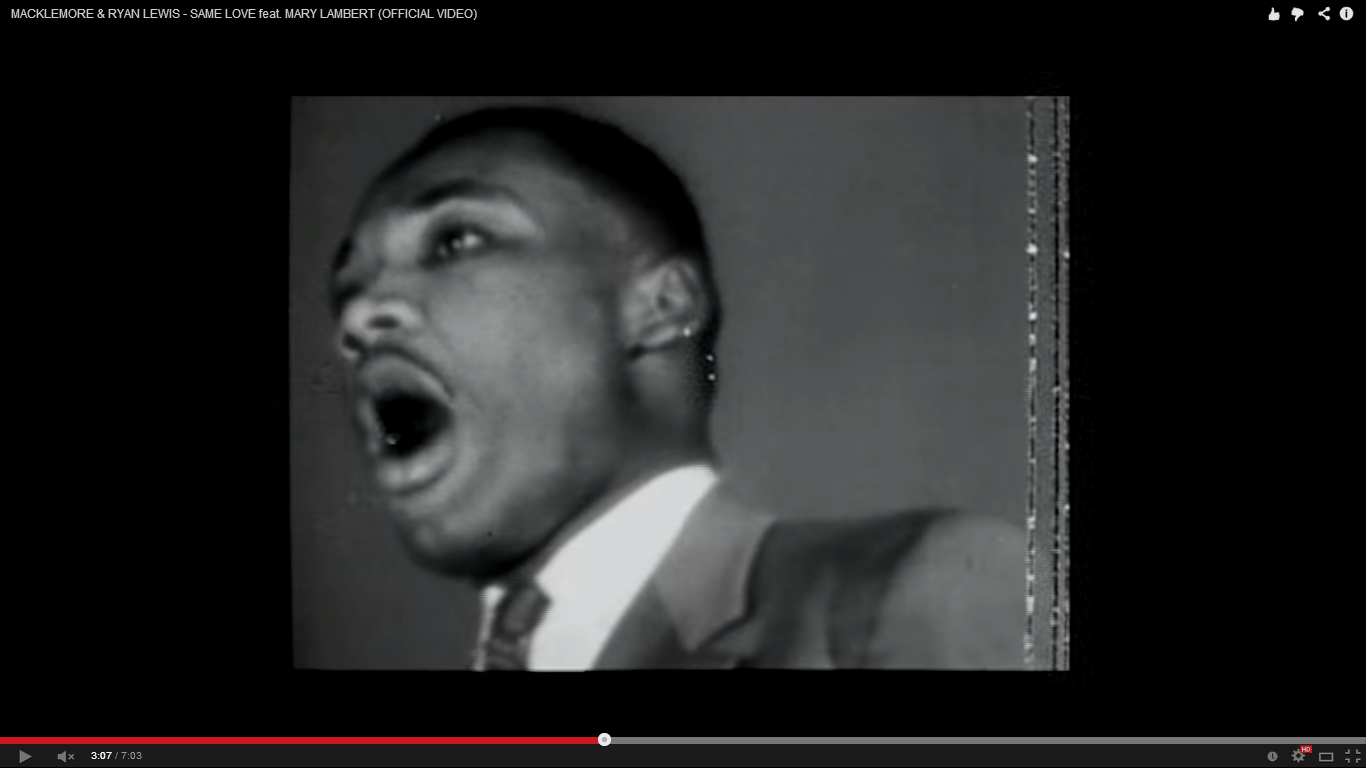
This image can be compared to adverts shown now-a-days such as the benetton advert that illustrates how attitudes amongst members of society have changed. Gay rights are becoming more acceptable in the 21st century and this is illustrated from the following images:
The music video as a whole illustrates how attitudes towards gay couples, in a post-modern society, are negative and how it has to change and become more acceptance as times have changed.
Subscribe to:
Posts (Atom)